
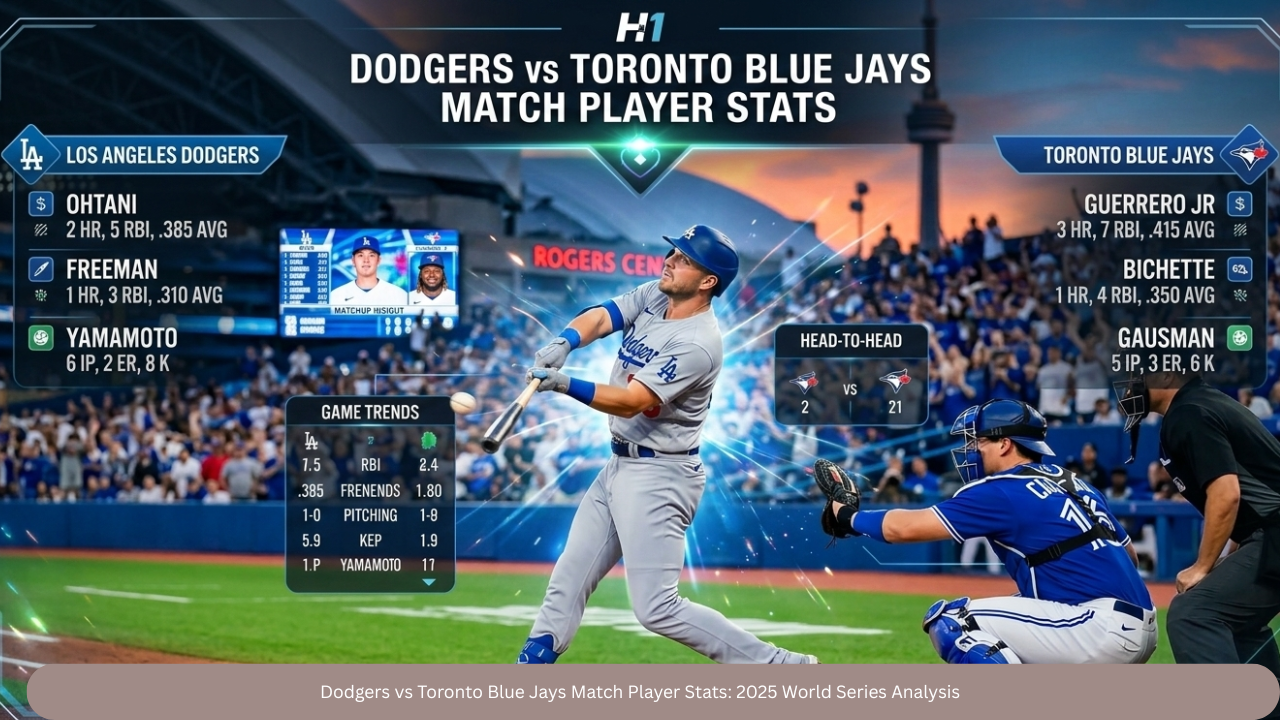
The rivalry between the Los Angeles Dodgers and the Toronto Blue Jays reached a historic fever pitch during the 2025 MLB season, culminating in one of the most dramatic World Series matchups in modern baseball history. When fans search for Dodgers vs Toronto Blue Jays match player stats, they are looking for more than just box scores; they are looking for the story of how two of the most star-studded rosters in the league clashed on the biggest stage.
In this comprehensive breakdown, we dive deep into the individual performances, pitching masterclasses, and offensive explosions that defined the recent encounters between these two powerhouses. From Shohei Ohtani’s historic two-way contributions to Vladimir Guerrero Jr.’s legendary postseason run, every statistic tells a story of elite-level competition.
The Epic 2025 World Series Showdown
The 2025 World Series between the Dodgers and the Blue Jays was a seven-game thriller that captured the attention of the global sports world. It was a classic “East meets West” battle, featuring the high-octane offense of Toronto against the deep, seasoned roster of Los Angeles.
The Dodgers ultimately emerged as the champions, winning Game 7 with a 5-4 victory in 11 innings at the Rogers Centre. This victory made them the first repeat champions in 25 years. However, the path to that title was paved with incredible individual performances from both sides. To understand the gravity of this match, we must look at the specific player stats that moved the needle.
Shohei Ohtani: The Postseason Powerhouse
No discussion of Dodgers vs Toronto Blue Jays match player stats is complete without focusing on Shohei Ohtani. During the 2025 World Series, Ohtani proved once again why he is considered a once-in-a-century talent.
In the 2025 World Series, Ohtani posted a staggering slash line of .333/.500/.778, resulting in an OPS of 1.278. This level of production mirrored some of the greatest seasons in baseball history. His most notable performance came in Game 3, an 18-inning marathon where he reached base nine times.
While Ohtani’s pitching was limited due to the physical toll of the long season, his presence in the designated hitter spot was the primary engine for the Dodgers’ offense. He led the series in runs scored (146 during the regular season and leading the charts in October) and provided the power that forced Toronto’s pitchers into defensive counts throughout the series.
Vladimir Guerrero Jr.: A Historic Postseason Performance
On the Toronto side, Vladimir Guerrero Jr. put together what many analysts call the greatest single postseason by a hitter in the 21st century. If you are looking at Blue Jays player stats, Vladdy’s numbers are the gold standard.
Guerrero Jr. finished the 2025 postseason with an OPS of 1.289 over 18 games. He recorded 29 hits, 8 home runs, and 15 RBIs. In the World Series alone, he was a nightmare for Dodgers pitching, maintaining a batting average near .400 and an on-base percentage of .494.
His Game 4 performance was a highlight, going 2-for-4 with a towering two-run home run that helped the Blue Jays secure a 6-2 win and keep the series competitive. Despite the loss in Game 7, Guerrero Jr.’s 2025 campaign solidified his status as the face of the Toronto franchise and a perennial MVP candidate.
Yoshinobu Yamamoto: The Ace of the Series
Pitching is often the deciding factor in high-stakes matches, and for the Los Angeles Dodgers, Yoshinobu Yamamoto was the X-factor. His stats against the Blue Jays were nothing short of elite.
Yamamoto earned the win in both Game 2 and the decisive Game 7. In Game 2, he threw a complete-game victory, the first in a World Series since 2015 completely neutralizing a Blue Jays lineup that had just scored 11 runs in Game 1.
Over the course of the 2025 postseason, Yamamoto improved to a 5-1 record with a 1.56 ERA. His ability to use his splitter and high-90s fastball to navigate the dangerous middle of the Toronto order (Guerrero Jr., Bichette, and Springer) was the primary reason the Dodgers were able to survive the Toronto offensive onslaught.
Bo Bichette and the Blue Jays Core
While Guerrero Jr. took the headlines, Bo Bichette provided the consistent contact that fueled Toronto’s rallies. Bichette finished the 2025 regular season with a .311 batting average and 181 hits, ranking among the top five in the American League.
In the World Series, Bichette’s stats remained impressive. He recorded a .348 batting average during the postseason and was a key contributor in Game 7, hitting a third-inning home run off Shohei Ohtani to give Toronto an early 3-0 lead. His defensive play at second base was also a highlight, showing his versatility and commitment to the team’s new defensive alignment.
Other notable Blue Jays contributors included Addison Barger, who hit a pinch-hit grand slam in Game 1, and George Springer, who maintained a .381 batting average throughout the series. The Blue Jays’ depth was evident, as four of the five highest OPS marks in the series belonged to Toronto players, despite the Dodgers winning the title.
Will Smith and the Dodgers’ Clutch Hitting
The Dodgers’ victory was defined by “clutch” moments, and no player embodied this more than catcher Will Smith. In the 11th inning of Game 7, with the score tied 4-4, Smith hit a solo home run that eventually became the championship-winning run.
Smith finished the series as the second-highest performing Dodger behind Ohtani, posting an .886 OPS. His ability to handle a complex pitching staff while remaining a threat in the middle of the order was invaluable.
Another unsung hero was Miguel Rojas. Inserted into the lineup in Game 6 to provide a spark, Rojas hit a game-tying home run in the ninth inning of Game 7 against Blue Jays reliever Jeff Hoffman. These small-sample-size stats are often what decide championships, and the Dodgers’ veterans came through when the lights were brightest.
Mookie Betts and Freddie Freeman: The Veteran Presence
Mookie Betts and Freddie Freeman may not have posted the eye-popping home run totals of Ohtani, but their situational hitting was a cornerstone of the Dodgers’ strategy.
Betts was instrumental in Game 6, hitting a two-run single that helped force the deciding Game 7. Freeman, meanwhile, made history by becoming the first player to hit two walk-off home runs in a single postseason earlier in the month, though he faced tougher resistance from Toronto’s pitching staff, including Kevin Gausman and Max Scherzer.
Toronto’s Pitching: Gausman and the Ageless Scherzer
The Blue Jays’ pitching staff fought valiantly against the Dodgers. Kevin Gausman remained the workhorse of the staff, though he struggled in Game 6, allowing three runs over six innings.
A major story of the series was the performance of the 41-year-old Max Scherzer. Signed by Toronto to provide veteran leadership, Scherzer became only the fourth pitcher in MLB history to start multiple winner-take-all Game 7s. While he didn’t factor into the final decision, his presence and early-game dominance gave Toronto a legitimate chance to clinch their first title since 1993.

Key Statistical Takeaways from the Matchup
When analyzing the Dodgers vs Toronto Blue Jays match player stats, several key trends emerge:
First, the impact of the long ball was undeniable. Both teams relied heavily on home runs to generate runs, with players like Ohtani, Smith, Muncy, Guerrero Jr., and Bichette all leaving the yard in critical moments.
Second, the Dodgers’ bullpen depth proved superior in the extra-inning games. Winning both Game 3 (18 innings) and Game 7 (11 innings) required a level of relief pitching endurance that Toronto struggled to match in the final frames.
Third, the star power at the top of the lineups lived up to the hype. Often, superstars can cancel each other out in the postseason, but both Ohtani and Guerrero Jr. performed at an MVP level throughout the seven games.
Why These Stats Matter for Future Matchups
The 2025 World Series was not just an end but a beginning of a new era of cross-league rivalry. As we look toward the 2026 season and beyond, these player stats provide a blueprint for how these teams match up.
The Dodgers’ ability to combine high-end Japanese pitching talent like Yamamoto with a diverse offensive attack makes them a perennial favorite. Conversely, the Blue Jays have proven that their core of “Legacy” players (Guerrero Jr. and Bichette) has matured into a championship-caliber unit that can go toe-to-toe with anyone.
For fans and analysts, tracking these head-to-head stats is essential for understanding the shift in power within Major League Baseball. Whether it is a regular-season series in Toronto or another high-stakes meeting in October, the Dodgers vs Toronto Blue Jays rivalry is currently the gold standard of professional baseball.
Summary of Player Performance
In conclusion, the Dodgers vs Toronto Blue Jays match player stats from their most recent encounters show two teams at the peak of their powers. Los Angeles relied on the historic brilliance of Shohei Ohtani and the ice-cold pitching of Yoshinobu Yamamoto. Toronto countered with a legendary performance from Vladimir Guerrero Jr. and a deep, aggressive lineup.
While the Dodgers walked away with the rings, the stats show a series that was decided by the thinnest of margins, a single home run in the 11th inning of a seventh game. For baseball fans, there is no better indicator of the health and excitement of the sport than when two teams of this caliber meet and deliver on every expectation.
Also Read: A Deep Dive into plor4d85 pot: Mastering Your Digital Presence
[…] Also Read: Dodgers vs Toronto Blue Jays Match Player Stats: 2025 World Series Analysis […]