
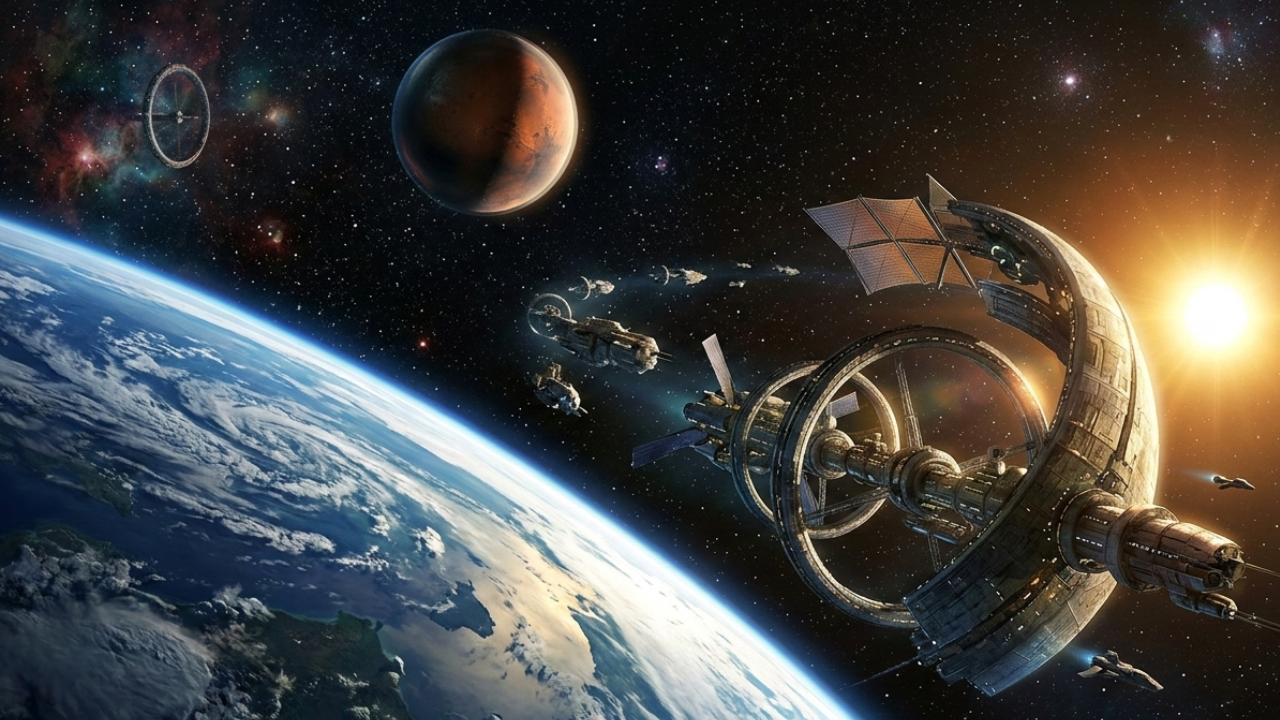
The concept of a farewell to life on Earth has shifted from the realm of science fiction into a serious discussion involving astrophysics, environmental science, and ethics. Whether we are discussing the eventual cosmic expiration of our planet or the ambitious leap toward becoming a multi-planetary species, the idea of leaving our home world is the ultimate human narrative.
This article explores the various dimensions of our departure from the scientific necessity, the technological hurdles of space colonization, and the profound emotional weight of saying goodbye to the only home humanity has ever known.
The Scientific Inevitability of a Solar Farewell
To understand the necessity of a farewell to life on Earth, we must first look at the clock set by our Sun. Currently, the Sun is a stable, middle-aged star. However, in approximately five billion years, it will exhaust its hydrogen fuel and expand into a Red Giant.
The Timeline of Terrestrial Habitability
Long before that final expansion, the Sun’s increasing luminosity will cause Earth’s oceans to evaporate and the atmosphere to strip away.
- 1 Billion Years: The Sun’s brightness increases by 10%, leading to a runaway greenhouse effect.
- 2-3 Billion Years: Earth loses its magnetic field and atmosphere, becoming a barren rock.
- 5 Billion Years: The Sun expands into a Red Giant, potentially swallowing Earth entirely.
The Great Migration: Mars and Beyond
When we discuss leaving Earth today, the conversation inevitably centers on Mars. As the most Earth-like planet in our solar system, it serves as the “Beta test” for human survival elsewhere. Companies like SpaceX and international agencies like NASA are already laying the groundwork for what could be the first permanent human departure.
Requirements for a New Home
A farewell to life on Earth to settle on Mars involves more than just a long rocket ride. It requires the mastery of several key technologies:
- In-Situ Resource Utilization (ISRU): Converting Martian CO2 into breathable oxygen.
- Radiation Shielding: Protecting colonists from solar flares and cosmic rays.
- Sustainable Agriculture: Growing food in Martian regolith using hydroponics.

The Ethical Dilemma of Leaving Earth Behind
As we contemplate a farewell to life on Earth, we face a grueling ethical question: Who gets to go? The prospect of space colonization carries the risk of creating a “lifeboat” scenario in which only the wealthiest or most elite segments of society can escape environmental or cosmic catastrophes.
Planetary Protection and Responsibility
- Biological Contamination: The risk of Earth microbes destroying potential alien life.
- The “Abandonment” Argument: Does focusing on space travel distract us from fixing climate change?
- Human Rights in Orbit: Establishing a legal framework for settlers who no longer live under Earth’s laws.
Technological Barriers to a Deep Space Farewell
If we are to truly say farewell to Earth and move beyond our solar system, our current chemical rockets are woefully inadequate. Reaching the nearest star system, Proxima Centauri, would take tens of thousands of years with current technology.
Future Propulsion Methods
To make a deep-space farewell possible, we need breakthroughs in physics and engineering:
- Nuclear Thermal Propulsion: Using reactors to heat propellant for faster travel.
- Solar Sails: Utilizing the pressure of sunlight to push ultra-light spacecraft.
- Antimatter Engines: The theoretical pinnacle of efficiency, though currently beyond our reach.
The Environmental Crisis as an Accelerated Farewell
While cosmic timelines are long, human-induced environmental changes are creating a much faster, more somber farewell to life on Earth as we know it. We are currently living through the Holocene extinction, a period where species are disappearing at unprecedented rates.
Signs of the Early Departure
- Rising sea levels are forcing island nations like Kiribati to abandon their homes.
- Mass Migration: Climate refugees moving away from uninhabitable equatorial zones.
- Biodiversity Loss: The permanent loss of thousands of plant and animal species every year.
The Psychological Weight of a Planetary Goodbye
What does it mean for a human soul to leave Earth forever? Every piece of art, every note of music, and every historical event has occurred within the thin layer of Earth’s atmosphere. Our biology is tuned to the 24-hour cycle of Earth’s rotation.
The Overview Effect and Solastalgia
- The Overview Effect: A cognitive shift experienced by astronauts seeing Earth as a fragile “blue marble.”
- Solastalgia: The psychic pain caused by the loss of one’s home environment.
- Intergenerational Stress: The trauma of children born in space who will never feel wind or rain.
The Digital Farewell: Uploading Consciousness
A more radical theory regarding our farewell to life on Earth involves the digital realm. Some futurists believe that our physical bodies are too fragile for space travel. Instead of sending flesh and bone to the stars, we might “upload” our consciousness into silicon substrates.
Advantages of a Digital Existence
- Durability: Data can survive the vacuum of space better than biological tissue.
- Speed: Digital minds could “travel” at the speed of light via radio waves.
- Resource Efficiency: A digital colony requires far less oxygen, water, and space.
Preserving the Legacy of Our Home World
Regardless of how or why we say farewell to life on Earth, preserving our legacy is paramount. If humanity leaves, we carry the Earth with us in our stories, our DNA, and our digital archives.
Modern “Time Capsules”
- Svalbard Global Seed Vault: A backup for Earth’s botanical history.
- The Arch Mission Foundation: Storing human knowledge on nickel nanodisks on the Moon and Mars.
- DNA Data Storage: Encoding the entirety of human history into synthetic DNA strands.
Conclusion: Our Place in the Cosmos
A farewell to life on Earth is the most daunting and inspiring concept in human history. It challenges us to look beyond our short-term struggles and consider our place in the cosmic timeline. Whether driven by the cooling of our planet, the heating of our Sun, or the unquenchable fire of human curiosity, the departure from Earth will be the defining moment of our species.
As we stand on the threshold of becoming a spacefaring civilization, we must cherish the time we have on this “Pale Blue Dot.” The more we prepare for an eventual farewell, the more we realize how precious and unique our home truly is.
Also Read: Growth Navigate Funding: The Strategic Blueprint for Scaling Your Business
[…] Also Read: Farewell to Life on Earth: Navigating the Final Frontier of Human Existence […]